
When Min Wang answered a phone call from her doctor at the Fox Chase Cancer Center three years ago, she considered herself a typical, 38-year-old Chestnut Hill mom, chasing a toddler around between stints at the office. She had no risk factors for breast cancer. So the news was shocking: Wang had developed cancer in her right breast, and doctors later found that the disease had already spread to her lymph nodes. “I won’t be forgetting that day,” Wang said. “It was hard for me to reconcile: I’m a runner, I’m a researcher, I’m an artist, I’m a mom. Oh, God, I’m a cancer patient.”
Women under the age of 45 are increasingly at risk of developing breast cancer. Allison Aggon, a Fox Chase oncologist and surgeon who served as one of Wang’s doctors, said that since 2012, breast cancer incidence among women under 45 has increased steadily, by about 1% each year. The increase has been observed across all racial groups, but particularly among minority populations, and researchers still do not yet know why.
Currently, about one in eight women in the United States will receive a breast cancer diagnosis in their lifetime. More than 27,000 women under the age of 45 are now diagnosed each year, even though routine screening guidelines have historically focused on older women.
“We traditionally think of breast cancer as something that happens to women in their seventies,” Aggon said. “But we’re seeing more and more of it in women who are traditionally too young for screening. So it’s really important for women and health care providers to be aware that our historical thought of ‘You’re too young to get breast cancer’ is not necessarily true anymore.”
Some medical organizations have shifted their guidelines in light of the rising incidence. The U.S. Preventive Services Task Force, for instance, a national panel of medical experts, now recommends screening mammograms every other year for women ages 40 to 74. Aggon said Fox Chase recommends annual mammograms starting at age 40 for women of average risk, but earlier or supplemental screening may be appropriate for women with elevated risks.
“It’s really important for women and health care providers to be aware that our historical thought of ‘You’re too young to get breast cancer’ is not necessarily true anymore.”
— Allison Aggon, Surgical Oncologist, Fox Chase Cancer Center
The center’s oncologists recommend that all women over the age of 25 undergo formal risk assessment for breast cancer that takes into account factors including a family history of the disease, prior breast biopsies or high-risk findings, breast density, and reproductive and hormonal history. Fox Chase’s Risk Assessment Program can help by providing genetic testing and evaluations of breast density and reproductive and hormonal history to inform an individualized action plan. That could include earlier or more frequent screenings, advanced imaging, hormone therapy, or surgery.
“The Risk Assessment Program is a really nice place for high-risk women to be monitored on an annual or semiannual basis. This is a great program for evaluation, coming up with a plan to manage risk, and to see that plan through,” Aggon said.
Fox Chase has created other services to address the changing risks for breast cancer. In January 2025, the center launched its Young Adult Cancer Program, which provides holistic care specifically designed for the challenges faced by cancer patients aged 18 to 39. “They help to navigate the unique challenges that this age group has,” Aggon said. A cancer diagnosis may have difficult implications for, say, a young person’s work and school life, finances, mental health, and family responsibilities. As a result, the program takes a coordinated approach, addressing these issues alongside treatment and integrating support networks into their plans rather than leaving young adults to balance these challenges on their own.
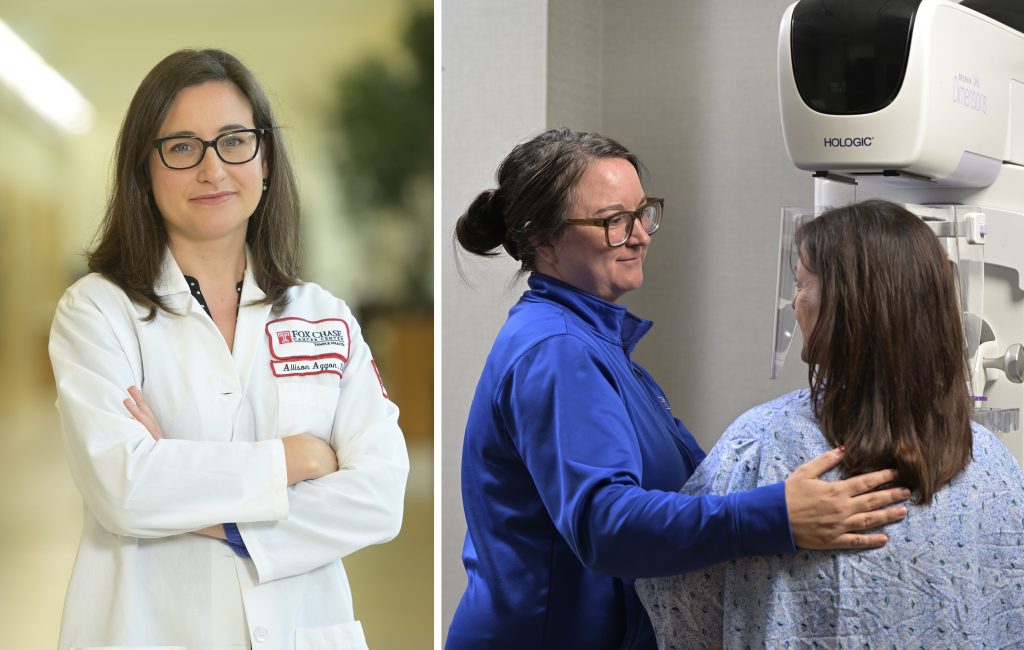
The center also offers specialized care for those diagnosed with breast cancer before age 50, considered to have early-onset of the disease, as well as those who are diagnosed before age 45, like Wang, whose risk of developing the disease are increasing. All patients are evaluated by a multidisciplinary team of specialists in surgery, medical oncology, radiation, imaging, and supportive care.
For Wang, it was important to have access to such professionals at Fox Chase, which is one of just five NCI-designated Comprehensive Cancer Centers in Pennsylvania. But just as important was the quality of the bedside manner she experienced there.
“I was so scared,” Wang said. “Everyone I encountered [at Fox Chase] was just very caring and very sensitive to what I was going through.”
A Road Map to Understanding Risk
Aggon emphasizes that it’s not just Fox Chase’s oncologists who urge women to begin thinking about their breast cancer risk at a young age. Guidelines from the American College of Radiology also recommend that women discuss breast cancer risk with their doctor by age 25. “A number of individuals fall through the cracks because they don’t have that conversation, and they really should start screening earlier because of their family history,” Aggon said.
If there are no risk factors that warrant earlier evaluation, women should begin annual screening at age 40. At that age, Aggon said, Fox Chase’s care teams generally recommend 3D mammography, which can increase the chances of an accurate scan.
But all women, regardless of their risk factors or age, should remain vigilant for changes in their breasts, Aggon said. That includes watching for changes such as a new lump, discharge, or a nipple retraction.
“Don’t assume it’s benign and will go away,” Aggon said.
Such vigilance proved potentially life-saving for Wang, who had no known risk factors for breast cancer. About a year before Wang’s diagnosis, a friend in her 50s told Wang about her own breast cancer diagnosis. “I’ll always be grateful for her saying, ‘I know you’re young, but just start checking,’” Wang said.
The conversation stayed with Wang for a few months before she performed a self-examination and found a lump. Her doctor ordered a mammogram, and when the results were inconclusive, Wang underwent an ultrasound and biopsy that led to her diagnosis.
Wang urges women to pay attention to changes in their breasts, advocate for themselves, and bring questions and concerns to their health care providers. “It doesn’t hurt to be more careful,” Wang said. “But it will hurt if someone told you to ignore it.”
Care for the Whole Patient
Despite receiving a “really good prognosis” from her care team, Wang’s treatment journey was not easy. First, she underwent a surgical mastectomy, which her doctors recommended due to the size of her tumor. Then, doctors found that the cancer had spread to her lymph nodes. Wang underwent 20 weeks of chemotherapy and five weeks of radiation. Afterward, her care team told her that they found no remaining evidence of disease.
The logistical burden of this rigorous treatment regimen was eased, Wang said, by the fact that she could walk from her home to Chestnut Hill Hospital, which, like Fox Chase, is part of the Temple University Health System. Fox Chase also offers cancer screening and care at numerous locations in the Philadelphia area, including in Montgomery and Bucks counties.
Now, Wang is undergoing hormone therapy to reduce the risk of recurrence.
“Chemo was so freaking hard. I don’t wish that on anybody,” Wang said, while crediting Fox Chase’s team for helping her through the challenges.
According to Wang, Aggon, who performed the mastectomy, presented a “positive and upbeat” bedside manner throughout her treatment, as did other care providers. Wang’s background in health care often helps her establish a rapport with medical professionals. Still, she said her team at Fox Chase was exceptional, connecting with her and recognizing her vulnerability.
Wang also said that the team’s care and attention to detail continued after she completed chemotherapy and radiation. Fox Chase oncologist Michael Seidman recently told Wang about an ongoing clinical trial of a drug that may be “even better at preventing recurrence” than the treatments she currently receives, Wang said.
She advises that anyone who comes face-to-face with cancer do all they can to keep themselves mentally and physically strong, something she had fortunately begun while working to regain her fitness after pregnancy. “I think if I hadn’t gotten my physical condition in a slightly better shape, it would have been much harder to go through surgery, recover from all that, and then go through chemo and radiation,” she said.
She also advises patients to be kind to themselves. “Fatigue can make it hard. But slow down and do things that make you happy. Spend time with people you love, and know that no matter what you’re going through, you’re still yourself. Never lose that.”
“Unfortunately, I had this thing happen to me, but it doesn’t define who I am,” Wang said.
Young women like Wang who are concerned about their family history, breast density, or other potential risk factors for breast cancer should speak to their health care provider. Those in the Philadelphia region may consider Fox Chase’s Risk Assessment Program, where physicians evaluate their personal and family history, offer genetic counseling or testing, and develop individualized screening and risk-reduction recommendations.